TECHNICAL DOSSIER // AUTONOMOUS SYSTEMS & NETWORK ENGINEERING
PENS INFORMATICS · REF: AGY-PEN-2027

Shevanka Bagus
Dwiyudi Kurniawan

Software Engineering & Network Systems
Systems Programming · Network Protocol Engineering · Defensive Cybersecurity
Target Context // KRTI PENS 2027 — EFRISA Programmer

Applying as Programmer for the Kontes Robot Terbang Indonesia (KRTI) PENS EFRISA Division. Technical focus: low-level systems programming in C/Python, deterministic packet telemetry protocols, hardware-software integration, and fault-tolerant system resilience under mission-critical operating constraints.

D4 Informatics Engineering student at Politeknik Elektronika Negeri Surabaya (PENS) (GPA: 3.62 / 4.00). My engineering practice integrates backend systems, protocol analysis, and defensive cybersecurity: I build a system, locate its architectural failure modes, test it empirically against standard threat models, and document reproducible mitigations. Work presented here is drawn from public repositories and hands-on lab environments.

Phone & Location +62 856 4348 1417 · Surabaya, East Java

Systems & Backend

  • Low-level C embedded runtimes & POSIX APIs
  • RESTful API architecture & MVC patterns
  • SQLite / MySQL relational database design
  • Process management & deterministic memory

Networking & Protocols

  • IPv4/IPv6 packet processing per RFC 791 / 1071
  • Hierarchical CIDR / VLSM subnet optimization
  • VLAN 802.1Q routing & CoPP rate limiting
  • Wireshark frame inspection & Packet Tracer

Security & Hardening

  • OWASP API Security Top 10 & BOLA/IDOR auditing
  • Active Directory DS & Tiered OU architecture
  • Group Policy (GPO) hardening & LAPS enforcement
  • Automated regression testing & threat modeling
Shevanka Kurniawan · Technical Portfolio & Dossier PAGE 01 / 06
SECTION 01 // CAPABILITIES MATRIX & ENGINEERING SPECIFICATIONS
TECHNICAL SKILLS

Technical Skills & Engineering Foundations

Technical competencies are structured across four core engineering domains. Rather than self-assigned percentage bars or arbitrary scores, capabilities are demonstrated through applied implementation across low-level runtimes, protocol implementations, directory services, and automated test harnesses.

Programming & Software Development

01
Core Languages
C (ISO C99/C11) Python 3.x JavaScript (Node.js) TypeScript Dart Java PHP SQL Lua 5.4
Architecture & Frameworks
Express.js Flutter SDK React 18 Laravel 12 RESTful API Design MVC / Clean Architecture Drift (Reactive SQLite)

Networking & Communication

02
Protocols & Standards
TCP/IP Protocol Suite IPv4 / IPv6 RFC 791 / 1071 / 1624 TCP SYN / ACK Flow UDP Datagrams ICMP Control Messages DNS DHCP
Routing & Network Operations
CIDR & VLSM (/12 to /30) VLAN 802.1Q Control Plane Policing (CoPP) RTBH Mitigation Wireshark Analysis Cisco Packet Tracer

Cybersecurity & System Security

03
Application Security & Testing
OWASP API Security Top 10 BOLA / IDOR Auditing JWT Authentication (HS256) Role-Based Access Control (RBAC) Threat Modeling CWE-639 / CWE-284 CVSS v3.1 Scoring
Infrastructure & Identity Security
Active Directory DS Group Policy (GPO) LAPS Password Management SMBv1 & LLMNR Deprecation PowerShell Logging (EID 4104) Burp Suite Nmap

Infrastructure & Tools

04
Platforms & Environments
Linux (Debian / Ubuntu) Windows Server 2022 Oracle VirtualBox (Host-Only) POSIX Shell (Bash)
Toolchain & Engineering Workflow
Git / GitHub VCS Node.js Runtime Vite GCC / Make Toolchain SQLite3 MySQL Figma (UI Specs)

Academic Standing & Curricular Focus

Degree & Major D4 Informatics Engineering (Teknik Informatika)
Campus Politeknik Elektronika Negeri Surabaya (PENS)
Cumulative GPA 3.62 / 4.00 (Scale 4.00, 2025–Present)
Core Subjects Data Structures, Computer Networks, Operating Systems, Database Systems, System Administration

Languages & Technical Communication

Indonesian Native proficiency (Primary language for documentation and coordination)
English Intermediate / Working proficiency (RFC standards, technical manuals, API specs, research)
German Elementary proficiency (Basic vocabulary and reading comprehension)
Documentation Markdown, technical test reports, architectural schematics, case study audits
Shevanka Kurniawan · Technical Portfolio & Dossier PAGE 02 / 06
FEATURED PROJECT 01 // APPLICATION SECURITY RESEARCH
OWASP API1:2023 · BOLA AUDIT

Student Project API Security Research & BOLA Audit

Empirical vulnerability analysis, automated regression test harness, and object-level policy remediation in a Node.js REST API.
Problem Statement & Research Objective

In multi-tenant web and backend architectures, applications frequently confuse authentication (verifying caller identity via tokens) with authorization (verifying whether that specific caller owns the requested resource). The objective was to construct a reproducible academic project service, model access boundaries, demonstrate cross-user data leakage through client-supplied path keys, and construct an automated regression test harness enforcing strict object-level access policies.

Technical Implementation
  • Backend Architecture: Developed a REST service utilizing Express and SQLite, supporting user authentication, profile reflection, private note management, and role-gated administrative inspection.
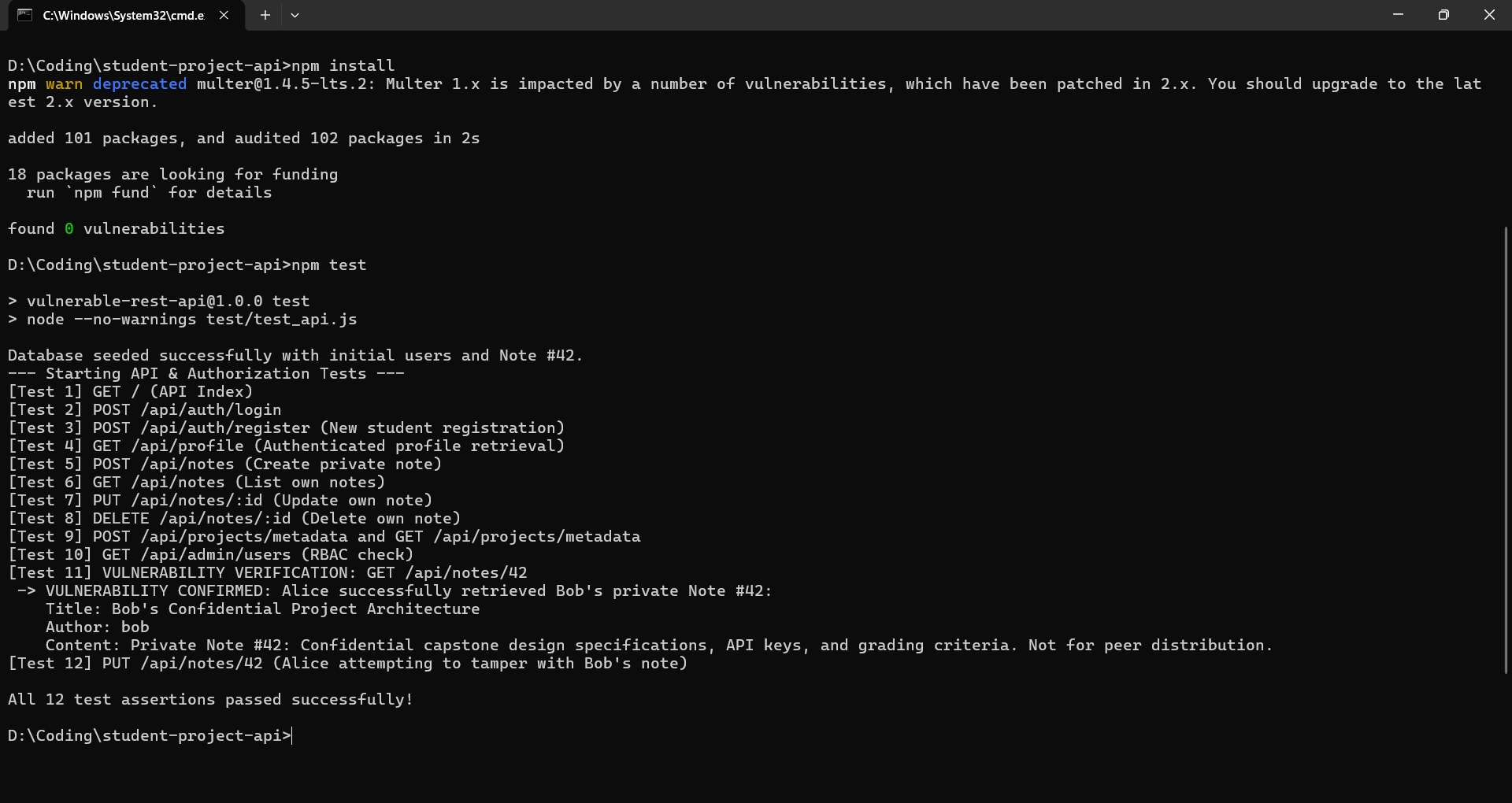
  • Flaw Isolation: Isolated the GET /api/notes/:id controller, which validated incoming JSON Web Tokens (JWT) but executed direct database lookups using unverified path parameters without evaluating ownership against req.user.id.
  • Remediation Strategy: Contrasted two mitigation patterns: query-level scoping (WHERE id = ? AND user_id = ?) vs controller-level policy enforcement (note.user_id === req.user.id || req.user.role === 'admin'), establishing uniform 403 Forbidden responses.
My Individual Contribution

Sole researcher and developer: Implemented the Express API, authored the 12-point automated regression test suite, conducted threat modeling against OWASP API Top 10, documented CVSS 7.5 vulnerability findings, and authored the remediation guide.

Empirical Test Results
Test Case Scope Vulnerable Baseline Remediated State Assertion
Auth & Profile Scoping 200 OK (Scoped) 200 OK (Scoped) Verified
BOLA Note #42 (Alice → Bob) 200 OK (Data Leak) 403 Forbidden Resolved
Admin Directory Access 403 Forbidden (Non-admin) 403 Forbidden (Non-admin) RBAC Enforced
Test Suite Performance 12 / 12 Passing · 218 ms total execution time
src/routes/notes.js VULNERABLE (main)
const noteId = parseInt(req.params.id, 10); // Authenticated JWT check passes, but missing ownership validation const note = db.prepare('SELECT * FROM notes WHERE id = ?').get(noteId); return res.status(200).json({ note }); // Returns any user's note!
research/bola-remediation REMEDIATED GUARD
if (note.user_id !== req.user.id && req.user.role !== 'admin') { return res.status(403).json({ error: 'Access denied: You do not own this note' }); }
Automated Test Suite Output showing 12 passing tests
E2E Test Suite Run: 12 Security Validations test/test_api.js
cURL exploit verification extracting Bob's private Note #42
Proof of Concept: Exfiltration of Private Note #42 HTTP 200 OK
Repository: github.com/Shevanka/student-project-api
Commit 81646e8acf (Audit) · Commit b67a46d (Remediation) · Verified
Case Study 01 · Student Project API Security Research PAGE 03 / 06
FEATURED PROJECT 02 // NETWORK SYSTEMS & PROTOCOL ENGINEERING
RFC STANDARDS · PACKET VERIFICATION

Computer Network Concepts & Protocol Simulation

Translating network protocol specifications into running Python validation engines, packet simulations, and optimized subnet designs.
Problem Statement & Engineering Objective

Practical network engineering demands moving beyond theoretical OSI models into deterministic protocol manipulation. The objective was to develop software test suites verifying bit-level IPv4 packet checksums per RFC specifications, evaluate router hop behaviors under TTL manipulation, model control-plane resource starvation (SYN and ICMP flood attacks), and architect an enterprise-grade hierarchical subnet topology using Variable Length Subnet Masking (VLSM).

Technical Implementation
  • RFC 1071 & RFC 1624 Algorithmic Validation: Implemented a Python engine performing 16-bit one's complement addition over IPv4 frame headers. Implemented RFC 1624 incremental checksum update HC' = ~(~HC + ~m + m'), verifying that intermediate routers can update packet checksums after TTL decrement in O(1) time without re-computing the entire 20-byte header.
  • Control Plane Policing (CoPP) & RTBH: Simulated ICMP echo, UDP amplification, and TCP SYN flood behavior. Applied CoPP rate limits (policing ICMP at 50 pps) and Remotely Triggered Black Hole (RTBH) routing via BGP community tagging to null-route attack traffic at edge ingress.
  • Hierarchical VLSM Subnetting: Designed address allocations from /12 down to /30 point-to-point links, isolating management networks, eliminating broadcast domain sprawl, and achieving an 88.28% address utilization efficiency.
My Individual Contribution

Sole author: Developed Python protocol validation test suites, engineered the VLSM mathematical allocation scheme, designed Packet Tracer topologies, and analyzed Wireshark packet captures.

Measurable Results & Specifications
Component Standard / Metric Observed Result
IPv4 Header Checksum RFC 1071 / 1624 Mathematical 0xFFFF verification; 100% match with Wireshark
TTL Decrement Delta RFC 791 / RFC 1624 Accurate single-cycle 16-bit inversion without full recalculation
VLSM Address Efficiency Subnet /12 to /30 88.28% utilized; 0 IP waste on P2P links
CoPP Control Plane Defense Rate-limiting & RTBH ICMP policed at 50 pps; CPU utilization maintained below 15%
RFC 791/1071 Packet Processing and VLSM Routing Architecture Pipeline
Architecture: Ingress Checksum Verification & CoPP Pipeline RFC 791/1071/1624
python/checksum_rfc1071.py PYTHON ENGINE
def calculate_checksum(header_bytes): # 16-bit one's complement sum calculation (RFC 1071) words = struct.unpack(f'!{len(header_bytes)//2}H', header_bytes) checksum = sum(words) while (checksum >> 16): checksum = (checksum & 0xFFFF) + (checksum >> 16) return ~checksum & 0xFFFF
Incremental Update (RFC 1624) HC' = ~(~HC + ~m + m')
def rfc1624_update(old_hc, old_m, new_m): # Recalculate checksum after TTL decrement without touching other bytes c = (~old_hc & 0xFFFF) + (~old_m & 0xFFFF) + new_m return ~((c & 0xFFFF) + (c >> 16)) & 0xFFFF
Repository: github.com/Shevanka/konsep-jaringan
RFC 791 / 1071 / 1624 Protocol Test Harness · Public Repository
Case Study 02 · Computer Network Concepts & Protocol Engineering PAGE 04 / 06
FEATURED PROJECT 03 // SYSTEMS & IDENTITY SECURITY
ACTIVE DIRECTORY HARDENING

Windows Domain Security & Hardening Lab

Isolated virtual enterprise infrastructure for analyzing centralized identity, Group Policy enforcement, and attack surface reduction.
Problem Statement & Systems Objective

Enterprise identity architectures predominantly fail not from underlying OS kernel flaws, but from configuration drift, legacy protocol retention (LLMNR, NBT-NS, SMBv1), and flat administrative access tiers that permit lateral movement. The objective was to architect an isolated virtual enterprise domain to study centralized identity boundaries, model credential dumping attack paths, and implement hardened Active Directory baselines.

Technical Implementation & Architecture
  • Isolated Virtual Infrastructure: Deployed a Windows Server 2022 Domain Controller and Windows 11 Enterprise workstations on a segmented VirtualBox Host-Only network (192.168.56.0/24) with zero external internet bridging to prevent telemetry or credential leakage.
  • Tiered Administration Model: Architected Organizational Units (OUs) following the Tiered Administration model: Tier-0 (Domain Controllers, Protected Users), Tier-1 (Member Servers), and Tier-2 (End-user Workstations). This prevents domain-level credentials from ever caching in lower-tier LSASS memory.
  • Group Policy (GPO) Hardening Baselines:
    • LAPS Implementation: Enforced Local Administrator Password Solution across domain endpoints, randomizing local admin passwords and neutralizing pass-the-hash vectors.
    • Poisoning Defense: Disabled LLMNR and NetBIOS over TCP/IP via GPO, neutralizing rogue Responder-style broadcast poisoning.
    • Protocol Deprecation: Disabled SMBv1 and enforced SMB Signing to thwart NTLM relay attacks.
    • Telemetry & Audit: Configured PowerShell ScriptBlock Logging (Event ID 4104) and command-line process auditing (Event ID 4688).
My Individual Contribution

Sole architect and administrator: Virtual machine provisioning, domain controller promotion (AD DS / DNS), directory schema partitioning, Group Policy authoring, and security verification.

Active Directory Domain Services Tiered OU and Hardening Topology
Domain Topology: Tiered OU Hierarchy & Hardened GPO Matrix CORP.LOCAL
Security Hardening Verification Matrix
Control Area Default Configuration Enforced Hardening State
Local Administrator Shared static password LAPS: Dynamic per-machine passphrases
Name Resolution LLMNR / NBT-NS active Disabled via GPO: Mitigates Responder
File Sharing Security SMBv1 enabled, signing opt. SMBv1 Removed; SMB Signing Required
Kerberos Encryption RC4-HMAC permitted AES-256-CTS-HMAC: RC4 deprecated
Host Auditing Minimal event logging EID 4104 & 4688: Full command logging
Repository: github.com/Shevanka/windows-domain-security-lab
Active Directory DS Hardening Homelab · Public Documentation
Case Study 03 · Windows Domain Security & Hardening Lab PAGE 05 / 06
SECTION 02 // SOFTWARE SYSTEMS, HONORS & CREDENTIALS
ENGINEERING RECORDS

Software Systems, Honors & Activities

Lua Engine — Embedded C Interpreter github.com/Shevanka/lua-engine

Custom embedded Lua 5.4 C runtime and script interpreter with modular C-bindings and an interactive REPL. Zero-dependency Makefile build; designed for embedded scripting and flight-computer telemetry integration.

C (ISO C99) Lua 5.4 API C-Bindings GCC / Make REPL
Budget Tracker — Offline-First Mobile App github.com/Shevanka/budget_tracker

Production-ready Android application for offline financial ledger management. Features Drift ORM (reactive SQLite), Riverpod state management, Google ML Kit on-device OCR for receipt scanning, and fl_chart visualizations.

Flutter Dart Riverpod Drift (SQLite) Google ML Kit OCR fl_chart
SI-KAYA (Dompet Harian) — Offline PWA github.com/Shevanka/si-kaya

Progressive Web App (PWA) expense tracking ledger with Service Worker caching for offline reliability, Web App Manifest for mobile installation, and a Python/Flask + SQLite backend synchronization API.

HTML5 / CSS3 JavaScript Service Worker PWA Python Flask SQLite
Portfolio Web Platform — React & TypeScript github.com/Shevanka/portfolio

Modern single-page web portfolio built in React 18, TypeScript, Vite, Tailwind CSS, and shadcn/ui. Features English/Indonesian localization, theme persistence, and automated component test suites via Vitest.

React 18 TypeScript Vite Tailwind CSS shadcn/ui Vitest
Flutter Android Application — GDGoC Capstone github.com/Shevanka/final-project-android-dev

GDGoC Binus Android Developer certification final project. High-fidelity Flutter UI implementation directly translated from Figma design specifications, state-driven widgets, and clean Dart architecture.

Flutter Dart Mobile UI Figma Spec GDGoC Capstone
Digital Library Application — Laravel 12 github.com/Shevanka/app-perpustakaan

Campus digital library management system built with Laravel 12, PHP, MySQL, and Blade templating following strict MVC architecture for book loans, cataloging, and administrative role management.

Laravel 12 PHP MySQL Blade MVC Architecture

Honors & Specialized Training

  • 3rd Place Winner — National BIONIX Competition (2024)
    Business and Information Technology Olympiad, national-level competition organized by Information Systems ITS. Evaluated on systems analysis and technology solutions.
  • Best IoT Project Award (2024)
    Awarded for hardware-software integrated IoT design, embedded sensor interfacing, and telemetry prototyping.
  • CEH v13 Curriculum — Self-Study (EC-Council)
    Independent curriculum study covering reconnaissance, network scanning, vulnerability assessment, web application security, and penetration testing methodologies in authorized virtual lab environments.
    * Independent curriculum self-study; does not represent an official certification.

Activities & Leadership

  • Liaison Officer — LKMM Tingkat Pra-Dasar (Oct 2026)
    Dept. of Informatics & Computer Engineering, PENS. Guided participant groups, managed schedule adherence, and coordinated inter-division logistics with the organizing committee.
  • Health Division Staff — Pekan Komunitas HIMIT PENS (Sep 2026)
    Informatics Student Association (HIMIT) PENS. Maintained medical readiness, emergency coordination protocols, and student welfare throughout community events.
  • Event Division Staff — Bakti Sosial Donor Darah (2025)
    EEPIS Bidikmisi Community. Managed donor scheduling, venue logistics, participant flow, and official coordination with Palang Merah Indonesia (PMI).
Shevanka Bagus Dwiyudi Kurniawan · D4 Informatics Engineering · PENS Surabaya
shevanka.kurniawan@gmail.com · +62 856 4348 1417 · github.com/Shevanka
